
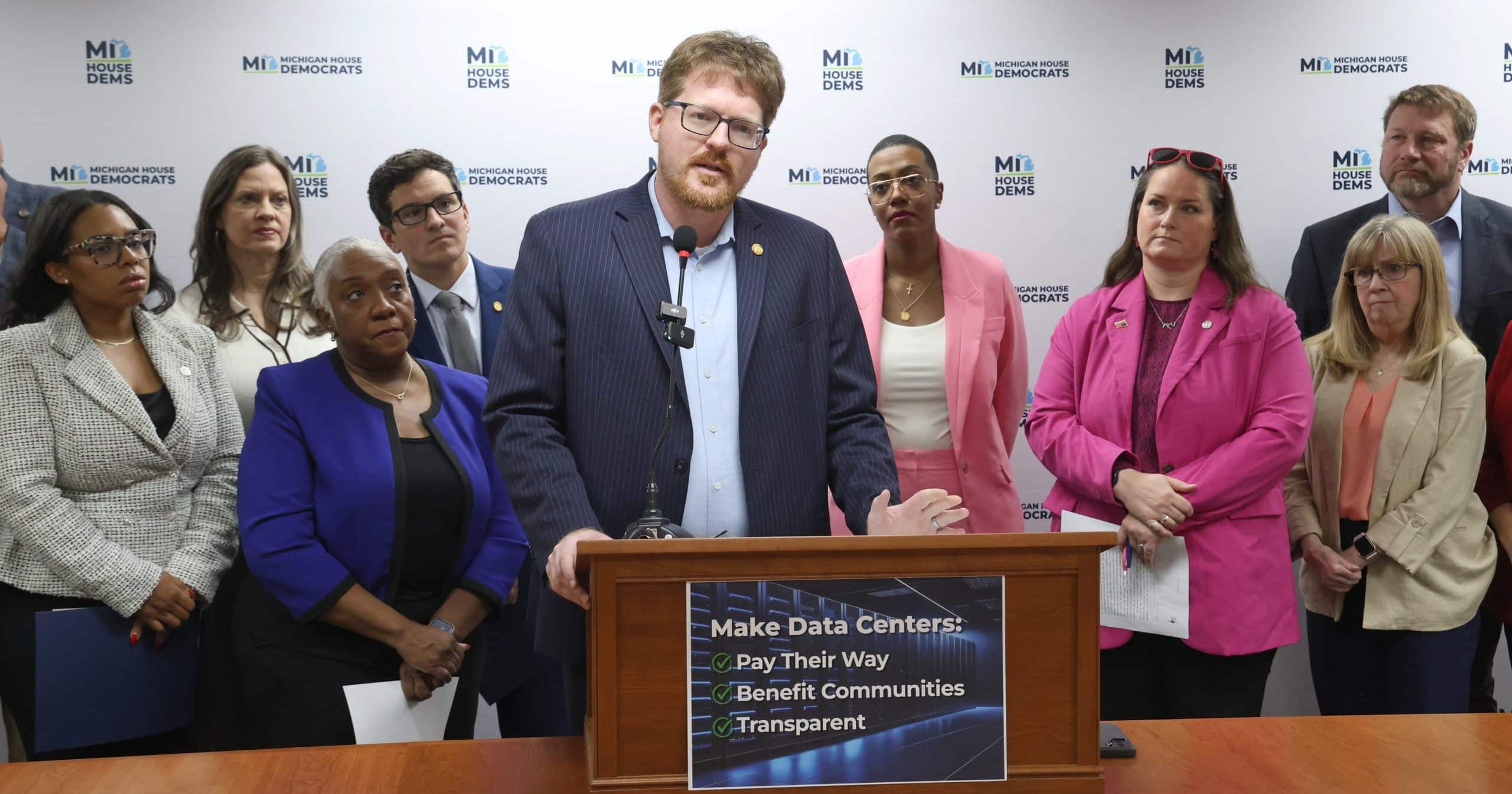
State Rep. Joey Andrews (D-St. Joseph) speaks at the Data Center Guardrail press conference, alongside fellow House Democrats.
LANSING, Mich., June 25, 2026 — This week, state Rep. Joey Andrews (D-St. Joseph), joined by fellow House Democrats, hosted a press conference to introduce House Bills 6135-6142, a legislative package placing guardrails on data centers. The bills would protect ratepayers and local communities from bearing the costs and impacts of rapidly expanding data centers.
“Data centers are here in Michigan, bringing tremendous opportunity for job and economic growth,” Andrews said. “At the same time, there are real concerns about their impacts on our environment, local communities and ratepayers. Our package responds to this urgent moment with straightforward legislation to strengthen guardrails that protect workers, communities, ratepayers and our environment, while keeping Michigan competitive for responsible development that benefits our state.”
The comprehensive bill package regulates noise pollution and requires a decommissioning plan to be in place prior to approval.
“Noise is one of the most immediate and tangible quality-of-life impacts communities experience from data center development, and it’s one of the least regulated,” state Rep. Helena Scott (D-Detroit) said. “Michigan currently has no requirement that developers evaluate and disclose potential noise impacts before a permit is issued. My bill in this package addresses that gap by ensuring those impacts are measured, reported and considered before construction begins.”
“Big tech companies are already talking about what the next iteration of their AI data centers might look like,” state Rep. Carrie Rheingans (D-Ann Arbor) said. “Communities across Michigan are rightfully worried that we’ll end up paying for the costs of decommissioning a data center decades after its construction or whenever the big tech companies declare them obsolete. This bill addresses those concerns by establishing clear expectations before construction ever begins. If a rich corporation profits from a facility, it should be responsible for cleaning up the environmental damage they caused. Taxpayers should never be left holding the bag.”
Additionally, the package requires both a community benefits agreement and a project labor agreement to be signed as a condition of Michigan Public Service Commission approval.
“As conversations around data centers continue to take place across our state, Michigan communities deserve an opportunity to advocate for themselves,” said state Rep. Kristian Grant (D-Grand Rapids). “My bill in the package ensures that the people who will live near these projects have a meaningful voice in shaping them and share in the benefits they create. Economic development is not about billion dollar projects, it is about investing in the quality of life for the people.”
“When data centers are built in Michigan, we must ensure they truly benefit everyday people and local communities, not just those who profit from them,” said state Rep. Stephen Wooden (D-Grand Rapids). “Local communities deserve the chance to ensure data centers hire local, further protect ratepayers, limit water use and ensure meaningful community investment through robust community benefits agreements.”
The package further enhances transparency regarding data center construction by prohibiting elected officials and data center owners from entering into non-disclosure agreements.
“If public money is going to these data centers, then the public has a right to know what they are getting in return,” state Rep. Morgan Foreman (D-Pittsfield Twp.) said. “Barring data center owners and elected officials from entering into NDAs will help guarantee that elected officials remain accountable to residents, not corporate confidentiality agreements. This is about protecting that basic democratic principle and bringing transparency to an area that is currently shrouded in darkness. Corporations can’t just show up in communities and dictate the state of play, the people must be informed and involved in this process.”
Further, the package establishes data centers as a distinct customer class, separate from industrial customers and ineligible for industrial rates, and requires service under a specific commercial tariff.
“Data centers are unlike almost any other customer that utilities have served before, as they demand constant power loads and require significant grid investment,” Andrews added. “That’s why House Bill 6135 ensures that Michigan families and small businesses don’t foot the bill for infrastructure built to serve hyper-scale data centers, and that all costs for generation, transmission, and distribution are borne by the data centers themselves, not existing ratepayers.”
Another provision prohibits new data centers from drawing on Michigan’s groundwater or surface water for cooling. Any data center must use either a closed-loop cooling system or water sourced exclusively from the municipal water system.
“As data centers place growing demands on our energy grid and water resources, we must ensure Michigan families aren’t stuck paying the price,” state Rep. Jason Morgan (D-Ann Arbor) said. “This legislation establishes critical safeguards, including my legislation, which will require closed-loop cooling systems that recycle water rather than drawing endlessly from the Great Lakes or local water supplies.”
“Michigan’s nation-leading data center standards are set to become even stronger,” Tom Lutz, Executive Secretary Treasurer, Northern Midwest Regional Council of Carpenters said. “By implementing labor standards for data center construction, these new bills will ensure that Michigan workers have access to rewarding jobs that turn into family-supporting careers.”
A recording of the press conference can be viewed here.
###