Dear Neighbor,
Welcome to my monthly Capitol and Community Updates e-newsletter! As your state representative in the 103rd Michigan Legislature, it has been a pleasure to provide these regular updates on my legislative work in an effort to be as transparent and informative as possible for constituents like you. In this issue, you will find a legislative update, including information on the status of the state budget, resources for how my office can assist you and more!
Neighbors and friends in House District 103 are encouraged to also sign up for these updates at my website, RepCoffia.com. You can reach my office by phone at (517) 373-3817 or by email at [email protected]. Be sure to check out the latest on my social media platforms as well. As this legislative session continues, I welcome your feedback and encourage you to reach out if my team and I can ever be of assistance to you!
In Service,
Betsy Coffia
State Representative
House District 103

Legislative Update
Below you will find highlights of recent legislative action. As always, legislation I have sponsored or co-sponsored this term can be found here. Real-time updates on my legislative work can also be found here.
State Budget
The statutory deadline to pass the state budget was July 1. While the Senate Democratic majority passed their general budget proposals in May and the Governor introduced her proposed budget even earlier, the House Republican majority waited until 35 days before a government shutdown could take effect to propose their own general budget plan. Without a single committee hearing on the 800-page bill, HB 4706 passed the House about an hour after its contents were made available to Democratic legislators and the public.
There are vast differences between the Senate and House proposed budgets, and there is not much time left for negotiations. If a budget is not passed by both chambers by Sept. 30, the state government will go into a shutdown on Oct. 1.
The following is a breakdown of the feedback that I have received from local schools, hospitals and small businesses in the 103rd District on the impact that these budget delays are already having on our communities, as well as the potential impact that the House Republican proposed budget would have on our students, families, health care patients and providers, businesses and workers and more, should the proposed House Republican budget be enacted as currently written.

Text: “Rep. Betsy Coffia: Serving Leelanau, Grand Traverse, & Benzie Counties: 103rd House District. Fighting for School Meals and a Strong K-12 Budget”
Schools & Education
Stability and knowledge of how much money is available for our schools are major reasons that the July 1 statutory deadline to pass the budget exists. This is why, when I was part of a Democratic House majority in 2023 and 2024, we prioritized getting a final budget passed and signed by the Governor by the July 1 deadline. We did so successfully both years. We understand that hiring, class size and much more is determined based on state funding and our local school leaders rely on us to provide that certainty in a timely manner.
I am disappointed that in a new session with divided government — House Republican majority, Senate Democratic majority — the House leadership’s delay to even provide a starting point for a full budget until after the July 1 statutory deadline has caused real issues in getting to a final budget. As the school year begins, district leaders have continued to be challenged by the absence of a K-12 School Aid Fund budget. Each day that funding and policy decisions remain in limbo, school services and programs hang in the balance of uncertainty. Continued legislative delays put the future of our schools — and most importantly, our students — at risk.
The lack of a state budget means that districts could miss out on their first scheduled state aid payment in October, which leaves the potential for significant harm to occur to staffing needs, student supports, transportation and essential programs. Michigan communities and taxpayers have done their job and provided funding meant to invest in our student’s success — and the Michigan Legislature must do the same.
I believe the path forward must include safeguarding the School Aid Fund — the fund voters were promised would be dedicated to K-12 education — rather than divert the use of those funds away from schools and students’ education. Our schools cannot operate indefinitely without these resources.
Additionally, the House-passed School Aid Fund proposal eliminates the rural school transportation equity formula that I championed in the last two state budgets. Rural school districts face higher school bus fuel and vehicle depreciation costs compared to urban districts, and they have come to rely on this formula to ensure that more money makes it into rural classrooms and student support systems. This funding is crucial for districts across Northwest Education Services’ school systems, and I cannot support a budget that does not include it.
Moreover, I also want to highlight the fact that many families are struggling to keep food on the table due to the high cost of groceries and federal Republican tariffs (more data on this below). I believe in meeting people where they are and providing financial breathing room to the average Michigander. The universal school meals program our Democratic trifecta passed in 2023 and 2024 not only kept kids fed, but it also helped local farmers and saved families an average of $850 a year per child in grocery bills. This year’s Republican-led House budget doesn’t include this line item to safeguard universal school meals, which could leave our kids, farmers and families behind. I believe the state has a responsibility to ensure that kids have guaranteed meals in the place we require them to be, and I will continue to advocate for what’s best for Northern Michigan’s kids and families.
Hospitals & Health Care Access
My office recently met with representatives from Munson Healthcare and statewide hospital advocates to discuss the potential impacts to hospital operations and patient care under the House-passed budget. Michigan’s hospital advocates have publicly raised concerns over the House Republican budget proposal which seeks to make what experts have deemed harmful cuts to hospital funding and healthcare measures. Munson laid out the following cuts that would negatively impact our local hospital’s ability to provide health care, including:
- New language placing $2.5 billion of hospital provider-tax funded payments in contingency, requiring unnecessary administrative and legislative actions that could jeopardize timely hospital payments.
- The House Republican proposed budget puts at risk $40-$50 million for Munson Healthcare.
- Elimination of at least $100 million of funding from the Specialty Network Access Fee (SNAF), which provides reimbursement to support physicians caring for patients with Medicaid coverage.
- This reduction in SNAF in the House Republican proposed budget would result in a cut of $100,000-$200,000 for Munson Healthcare.
- Elimination of $10 million to support the Maternal Levels of Care verification for birthing hospitals.
- Munson Healthcare Cadillac Hospital recently earned this verification and received $66,000 in state funding to support the program in FY25 – no further funding for this birthing support is available under the House Republican proposed budget.
This all comes at a time when Michigan hospitals already stand to lose more than $6 billion over the next 10 years due to federal budget cuts from the president’s administration and Republican Congress’ “Big Beautiful Bill.” Additional cuts at the state level are expected to further reduce access to health care services for patients and jobs for Michigan nurses, physicians and other staff employed by hospitals.
I strongly believe that we must work as a state toward increasing access to health care and supporting our workforce and quality patient care. I do not see these goals reflected in the House-passed budget. Therefore, I cannot support the House proposed budget as written.
Small Businesses & Workforce Support
Traverse Connect and the Northern Michigan Chamber Alliance recently sent my office a letter expressing their concerns regarding the FY26 budget reductions proposed by House Republicans that would significantly impact economic development and workforce programs essential to the prosperity of rural Michigan and the entire state.
Any budget we pass must invest in fiscally-responsible economic development and workforce programs that are proven to generate strong returns, address critical workforce and housing shortages and position rural Michigan as a key driver of statewide economic growth. Some of these programs include:
- The Office of Rural Prosperity (ORP) & Rural Readiness Grant Program
- The ORP administers the Rural Readiness Grant Program, which addresses the unique needs of rural communities, helping those without large grant-writing departments plan and prepare for strategic growth. For every $1 awarded in 2024, an additional $12 was invested to support community projects. Under Democrats in 2025, $2.5 million was allocated for ORP grants to rural projects, but the current Republican House budget fails to re-invest in this program that supports our rural communities.
- Michigan Business Development Program (MBDP) & Michigan Community Revitalization Program (MCRP)
- These programs have been essential in supporting both small and mid-scale business expansions and downtown redevelopment efforts in rural regions using $100 million in funding from last year’s budget under Democratic leadership. Since its inception, MBDP has provided critical gap financing to help employers expand in communities that otherwise would not have the resources to compete. MCRP has revitalized key downtown properties, turning underutilized spaces into housing, commercial and mixed-use developments that anchor rural economies by creating communities current and future residents are proud of and invest in. The Republican House budget eliminates funding for these programs that benefit rural economies.
- Going PRO Talent Fund
- This employer-driven training program directly addresses skilled labor shortages, particularly in rural regions. One example is Whistle Stop Childcare Center in Benzie County, where a grant enabled a childcare apprenticeship benefiting 13 working families. The Republican House budget proposes eliminating this $57 million economic development program.
- Employer-Assisted Housing Program
- The Governor’s executive budget recommendation proposed this new $25 million program, which would allow the Michigan State Housing Development Authority (MSHDA) to provide 1:1 match on employer investment for the creation of local workforce housing opportunities. The Republican House budget does not include funding for this program.
I have seen the benefit of these programs firsthand and heard loud and clear from my local business community the value they hold. The existence of the Office of Rural Prosperity is in large part due to long and patient advocacy by leaders in the northern Michigan business community.
These investments matter because rural Michigan generates billions in economic activity, supports industries from manufacturing to tourism and serves as a year-round base for residents, employers and entrepreneurs. Strategic investments in housing, workforce development, business growth and downtown revitalization multiply returns, strengthen public-private partnerships and keep talent in the state.
As your state representative in the 103rd House District, I am advocating for a final budget that restores and retains funding for high-impact programs like those listed above, and supports northern Michigan’s role in driving statewide economic competitiveness.

State Rep. Betsy Coffia speaks in committee.
Pedestrian Bridge Update
On Sept. 10, I met with Michigan Department of Natural Resources (DNR) Director Scott Bowen to continue discussions around replacement of the pedestrian bridge over U.S. Highway 31 near the Keith J. Charters Traverse City State Park.
I appreciate the DNR coming to the table to honor Director Bowen’s commitment to replacing the pedestrian bridge, a crucial piece of safety infrastructure in our community.
The current pedestrian bridge is owned by the DNR. It was built in the 1960s after a child was tragically killed crossing the highway. The DNR worked with the community at that time to wisely implement a safe bridge to prevent local residents and visitors alike from directly interacting with traffic along U.S. Highway 31, a busy highway where traffic has only increased as the community has grown.
The DNR is currently overseeing a renovation of the state park using $8.5 million in federal American Rescue Plan Act (ARPA) dollars. These plans previously included removing the pedestrian bridge entirely, without replacement, in favor of a crosswalk and traffic light. The current bridge was removed this month on the advice of Michigan Department of Transportation due to its age, lack of compliance with the Americans with Disabilities Act (ADA), and more recently, structural damage due to being struck by a vehicle. However, due to vocal opposition and safety concerns from community members, as well as intervention by my office, the DNR later committed to working together with the local community and state lawmakers to replace the old bridge with a new ADA-compliant bridge.
At our most recent meeting, the DNR team provided schematics to inform potential designs for a new ADA-compliant pedestrian bridge and is now working to identify a new location for the bridge as well as funding sources for the project. There is more work to be done, but I am pleased to see that progress is being made. I look forward to continued discussions on this project with Director Bowen, along with my colleagues state Sen. John Damoose and state Rep. John Roth, both of whom have been vocal supporters of a new pedestrian bridge.
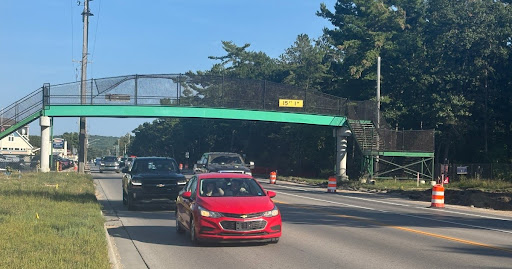
Pedestrian bridge over U.S. Highway 31 near the Keith J. Charters Traverse City State Park.
Tariff Impacts on Agricultural Economy
The Michigan Department of Agriculture and Rural Development (MDARD) released a new report indicating that surging federal tariffs under the President and the Republican-led Congress have increased food prices, reduced agriculture exports and generated uncertainty throughout Michigan’s food and agriculture industry.
According to the report, tariffs are raising costs and sowing uncertainty in Michigan’s food and agriculture sector, which is Michigan’s second largest economic sector and contributes nearly $126 billion to the state’s economy each year. Food and agriculture businesses support more than 800,000 jobs in Michigan.
In 2024, prior to the administration’s tariffs, Michigan set a new state export record by exporting nearly $3 billion of food and agriculture products. Comparing the first half of 2025 to the same period last year, Michigan’s:
-
- Soybean meal exports fell by 46%
- Wheat exports declined 89%
- Fresh cherry exports fell by 62%
- Fresh apple exports declined 58%
The report shows that tariffs are not only raising the cost of food, they are also making it more difficult for Michigan farms and food businesses to sell in international markets. Several countries responded to the president administration’s tariffs with retaliatory tariffs of up to 140% on U.S. agriculture goods. These retaliatory tariffs are drying up export markets that Michigan farmers and producers depend on.
Additionally, tariffs are driving up the cost of packaging used for food products. Steel and aluminum tariffs could increase canned food manufacturers’ costs by up to 12% — costs which are expected to be passed on to consumers.
Tariffs are taxes on goods imported into the United States. They are paid by the person or company that imports the goods. Companies often pass some or all tariff costs on to consumers in the form of higher prices.
During the current president’s first administration, retaliatory tariffs cost Michigan farmers more than $277 million in export revenue. Increased tariffs under the Republican Congress and the president’s administration are bringing greater uncertainty for Michigan food and agriculture businesses while putting agriculture jobs and families who depend on affordable food at risk.

State Rep. Betsy Coffia, left, and MDARD Director Tim Boring advocating for Michigan’s cherry industry at a press conference in August 2024.
Additional Updates
- Coffia Provides Update on Traverse City Pedestrian Bridge Replacement
- Coffia Champions Democratic K-12 Budget Proposal, Condemns GOP Version to Defund Necessary Student, School Supports
- Coffia Joins State, Local Leaders in Opposing Reckless Cuts to Medicaid and Public Service
- New MDARD Report Warns of Tariff Impacts on Food Prices, Agriculture Industry
- MDARD Confirms First Case of Eastern Equine Encephalitis for 2025 in a Benzie County Horse
- Gov. Signs Directive to Help Michiganders Afford Health Insurance After Passage of Republican Budget Bill
- Governor Highlights Impacts of Tariffs on Michigan Families During Back-to-School Season
Vision Project Survey – Share Your Input!
Northern Michigan deserves better. House Democrats are taking on corporate greed and political games to rebuild our schools, roads and environment and improve access to affordable housing, food and medications.
I’ve been part of the Vision Project’s core team shepherding this project since winter, and now it’s your turn to shape it. We’re launching our House Democrats’ Vision Project to hear directly from you about what matters most.
Your voice guides our work. What’s most important to you? Take our brief survey to share your vision for Michigan here.
Child Care Worker Benefits Expansion
Northern Michigan is powered by care — and our child care workers are at the heart of it. As communities Up North know, finding and keeping early childhood educators in rural communities is getting harder every year. That’s where the Nurture Benefits Program steps in.
A new statewide effort is expanding benefits for child care professionals across the state— including health insurance, life insurance and retirement options. Programs like this are critical in Northern Michigan, where child care deserts and worker shortages are leaving families without options and providers without support.
If you live or work in Northern Michigan and want to build a future where child care is a respected, sustainable career, check out how this program is helping. Applications will open this fall, and benefits start January 2026.
Food and Nutrition Resources
Buying food is expensive right now, especially for our neighbors struggling to put food on the table. Double Up Food Bucks is here to help! For those who shop for groceries with a SNAP/Michigan Bridge Card, they can double their benefits to purchase fresh, Michigan-grown fruits and veggies using Double Up Food Bucks. The program is available at 230+ participating farmers markets, farm stands, and grocery stores across Michigan. Learn how it works and find a participating location near you at DoubleUpFoodBucks.org.
School districts have partnered with local organizations to provide everyone age 18 and under with delicious, healthy meals. All summer, children and teens can eat healthy meals at sites in their communities at no cost. This year, there are even more sites to serve children in rural areas. Additionally, some locations provide Summer Meals To-Go through the Rural Non-Congregate program, which can be picked up. You do not need to apply, just show up and enjoy a meal. Use the map to find the location nearest to you!
Free Gun Locks Available
Free gun locks are available at Michigan Department of Health and Human Services (MDHHS) county offices and some local health departments through a partnership between MDHHS and the Michigan State Police. The cable-style gun locks are being offered as part of an effort to protect children from unsecured firearms. Gun locks are available while supplies last and can also be obtained through Project ChildSafe police partners across the state. Find more information at ProjectChildsafe.org.
Last year, Michigan’s secure storage law went into effect, requiring that individuals safely store firearms when a minor is likely to be present on the premises. Gun locks, like the cable-style locks distributed by MDHHS, are a vital resource for ensuring safe firearm storage and saving lives. More information and resources available here.
Apply for State Boards and Commissions
The governor makes appointments to nearly 250 statewide boards and commissions. These appointments are opportunities for Michiganders to engage with their state government on the issues they care about and represent their expertise and communities at the state level.
Vacancies can be viewed online. Each board listed includes the number of total members, number of vacant seats, and specifications for each vacancy.
E-News Archives, Publications and Recognitions
My e-news archive is available on my website here.
State publications on various topics – including veteran benefits, senior resources, and taxpayer support – are also available here. Physical copies of any of these publications can also be mailed to you by emailing my office with your request!
Do you know someone in the district who is retiring and would like a legislative tribute to celebrate their years of service? Has a local team or group reached a milestone that they would like to be acknowledged with an official certificate for each member? Our office can provide legislative tributes, letters and certificates on a wide range of recognitions for constituents, community support organizations and local small businesses. If you would like to request any of these materials for yourself or others, please fill out this form or email my office at [email protected]. Please provide as much information as possible, and we will work with you to arrange delivery or presentation of the recognition!