Dear Neighbor,
Welcome to my monthly Capitol and Community Updates e-newsletter! As your state representative in the 103rd Michigan Legislature, it has been a pleasure to provide these regular updates on my legislative work in an effort to be as transparent and informative as possible for constituents like you. In this issue, you will find information on my upcoming events, a legislative update, including information on the finalized state budget and an update on the pedestrian bridge project, a survey seeking your input on state priorities, resources for how my office can assist you and more!
Neighbors and friends in House District 103 are encouraged to also sign up for these updates at my website, RepCoffia.com. You can reach my office by phone at (517) 373-3817 or by email at [email protected]. Be sure to check out the latest on my social media platforms as well. As this legislative session continues, I welcome your feedback and encourage you to reach out if my team and I can ever be of assistance to you!
In Service,
Betsy Coffia
State Representative
House District 103

Legislative Update
Below you will find highlights of recent legislative action. As always, legislation I have sponsored or co-sponsored this term can be found here. Real-time updates on my legislative work can also be found here.
State Budget
After 10 months of discussions and negotiations, the Michigan Legislature has finally passed the 2025-2026 state budget.
The governor released her executive budget recommendations in February, and the Democratic-majority Senate passed their general budget proposals in May. However, the Republican-majority House released their general budget proposals in late August, despite the statutory deadline to pass the state budget being July 1. That left the legislature with 35 days to negotiate the budget before a government shutdown would take effect on Oct. 1.
Despite intense negotiations between the House Speaker, Senate Majority Leader and the governor, the state budget was not finalized ahead of 12 a.m. on Oct. 1. However, we in the legislature acted to pass and the governor signed into law a stop gap continuing bill that kept state government funded at the prior fiscal year’s funding levels through Oct. 8 to give more time for a budget agreement to be reached. Michigan’s state government shut down for about four hours in the early hours of Oct. 1 while we were in session voting to enact the measure, though the brief shutdown had no significant impact on state government operations.
The Michigan Legislature then passed the finalized $81 billion state budget that was reconciled between the Senate and House in the early hours of Oct. 3. The general omnibus budget HB 4706 passed the House by a margin of 101-8 and the School Aid budget SB 166 passed the House by a margin of 104-5. House Republicans were not able to procure at least 56 “yes” votes from their caucus alone, so House Democrats provided the votes needed to pass these budgets and avoid a potential continued government shutdown post-Oct. 8.
Two things; first, I do not believe that the current budget process is remotely adequate or sufficiently transparent. I have already been in direct conversation with my House Democratic Leadership about ways we can codify reforms to the budget process should we retake a Democratic majority, including a more stringent requirement for more budget details to be hammered out in committee and restrictions on how late a session can go into the night or early morning when the public is asleep and legislators and staff are susceptible to fatigue and error. Second, this was the first time in seven years in elected public office that I have been part of a budget not being done on time. All four years of my time as a minority member of the Grand Traverse County Commission and both years in the Democratic House majority in 2023 and 2024, we got the budget done before the statutory deadline.
I have been vocal to legislative leaders about my frustration with this year’s budget process and especially with the uncertainty it created for local schools and families. That being said, my colleagues in the House Democratic Caucus were fiercely insistent on advocating for the fairest and best outcome for our communities and vocal in our opposition to the significant cuts our House Republican colleagues proposed in their budget proposal.
Ultimately, I do believe that, given the extraordinary circumstances, what we landed on was a reasonable compromise for divided government, and I therefore proudly voted yes to pass it through the House by an overwhelming bipartisan margin. I have been clear from the beginning that my top priorities in this budget were collective wins for northern Michigan, including for our kids, schools, hospitals and patients, public safety, families and residents. I voted in favor of the final state budget because I believe it delivered on these priorities and avoided many of the cuts to crucial programs in the Republican House-proposed budget.
Highlights from the Fiscal Year 2025-2026 (FY25-26) state budget include:
- Record per-pupil funding at $10,050 per student, up from $9,608 in the last budget
- $203 million in bonuses for our hardworking teachers
- Continuation of the $125 million rural transportation equity funding formula for schools I had successfully championed in my first six months in the legislature – House Republicans’ proposed budget would have eliminated this new funding formula
- Continuation of universal school meals at no cost to students to save families time and approximately $850 per year per child at a time of skyrocketing grocery costs — House Republicans’ proposed budget sought to eliminate dedicated funding for the program
- Dedicated funding for special education ($205.5 million increase), at-risk students ($258.7 million increase) and school safety and student mental health ($321 million)
- $65 million in new funding for smaller K-3 class sizes
- Nearly $300,000 increase, up by 2.3%, for Northwestern Michigan College
- Preserves funding for arts and culture grants, $10.5 million was awarded in 2025 — House Republicans attempted to eliminate this funding
- Nearly $2 billion to fix crumbling local roads and infrastructure
- Continuation of support for police and fire departments — House Republicans’ proposed budget had advocated a 20% cut to the Michigan State Police
- Elimination of state taxes on tips, overtime and certain Social Security deductions for 3 years
- Continues the retirement tax repeal our Democratic trifecta enacted last term to save seniors on average $1,000 per year
- Protects Medicaid in Michigan to maintain access to health care, especially in rural and underserved areas
- Protects SNAP benefits and the Double Up Food Bucks program at a time when our local food banks are seeing huge increases in usage by families and seniors — House Republicans attempted to cut food assistance funding
- $17.1 million to raise wages for corrections officers, as there is currently a critical shortage
- Preserves $22.3 million in Going PRO funding to help employers train workers — House Republicans proposed eliminating the program entirely
- Mitigates the worst impacts of the federal so-called “One Big Beautiful Bill” to prevent a $1 billion budget hit and protect health care access, public safety, schools and more
- $14 million for Northern Michigan’s ice storm recovery
- $2.9 million for the United We Smile free dental clinic in Traverse City, a request I made last year and state Rep. John Roth made this year
- Funding for 20 additional PACE slots in Traverse City to support seniors aging in place
No budget is perfect, and this one is far from it, but the reality is that the President’s “One Big Beautiful Bill” made major cuts at the federal level that are projected to affect state funds, and our state budget had to reconcile with that and fill gaps where we could. Still, this overwhelmingly bipartisan budget is a significant step forward for Michigan, as it provides much-needed certainty for our local governments and schools, while also providing the resources and support to give our students the world-class education they deserve.
The work isn’t done, and I’m going to keep fighting for the priorities that I know matter most to our community in Northern Michigan.

State Rep. Betsy Coffia on Sept. 25 during her first day
back in session after her medical leave.
Rural School Transportation Funding
In 2023 during my first six months in office, I recognized that previous funding models for school transportation did not account for the unique challenges that rural districts face with sometimes hundreds of square miles over which to bus our students. That has unfortunately resulted in our students being shortchanged on funds available for their education compared to downstate, urban and suburban schools with much smaller, geographical footprints, as rural northern school districts for decades had been forced to spend as much as 10-15% of their general fund budget on gas and repairs to buses even before the students step off their bus and enter their classrooms.
This impacted the ability of schools with larger rural geographies, to support student success, mental health, arts, music and other important educational supports because they were spending money downstate schools had for those things, on gas and repairs instead. I grew up in Kalkaska County, whose school district literally had to shut down months early when it ran out of money and reopened with no busing to save money, which left parents to drive students across their more than 400 square mile school district.
That’s why during my first budget cycle in the Michigan Legislature in 2023, I championed this issue of rural school transportation equity by introducing House Bill 4335 as my first standalone policy bill. HB 4335 proposed to address the need for equitable funding for school transportation on a tiered per-pupil, per-mile basis. My bill received bipartisan co-sponsorship before its components were later incorporated into the FY23-24 state budget, which allocated $125 million for rural school districts’ transportation costs. The funding was preserved in the FY24-25 state budget as well.
While House Republicans proposed restructuring this categorical funding, my Democratic colleagues and I successfully negotiated the inclusion of the funding in the FY25-26 state budget. Rural school districts have come to rely on this funding, and I’m glad to see that there was ultimately a consensus about the importance of this funding formula for our students.
Pedestrian Bridge Update
As part of my continued efforts to facilitate a transparent process surrounding the Michigan Department of Natural Resources’ (DNR) plans to replace the pedestrian bridge over U.S. Highway 31 near the Keith J. Charters Traverse City State Park, I recently posed several questions to the DNR regarding the project and am sharing their responses below.
Cost Estimate
As securing funding for the new bridge is at the forefront of everyone’s minds, determining the true cost of the project has been a priority for me. We need a realistic price tag, and then we can explore the best funding sources to pay for a new ADA-compliant bridge. When asked about the cost estimate of the new bridge based on DNR’s proposed designs, the DNR reported that they received preliminary cost estimates from a contracted engineering firm to be used for early budgeting purposes.
The DNR stated that the design and construction of a bridge ranges from $6.75 to $8 million using the 2024 MDOT Average Price Report, with concrete and steel being the largest ticket items. A minimum of 5% increase in cost of this bridge per year should be factored in as we continue to discuss and find a location. These estimates do not include costs for land, right of way, or utility relocations which have the potential to be costly. It also assumes a property clean of environmental issues, no unexpected underground infrastructure and sized for adequate movement of all large construction equipment.
Site Location
I have been and continue to advocate that we use the land on both the state park’s beach and campground side that is already DNR-owned for a new ADA-compliant bridge. As the location of the new bridge could have an impact on the final cost of the project, answering the question of where the bridge could be placed is another key factor in these discussions. To narrow down placement options and avoid unnecessary future expenses, it’s important that we take any legal limitations into consideration early. The last thing we want is for these issues to arise further down the road when a change of plans would result in additional unexpected costs.
The new pedestrian bridge is not able to be placed in the same location as the previous bridge because of the proximity to the park’s new entrance and a new traffic light, which is part of the original $8.5 million American Rescue Plan Act park improvement project that has been approved by the federal government. I requested that the DNR investigate any potential legal parameters for the bridge’s placement, such as any distance or line-of-sight requirements in regard to the new traffic light.
The DNR stated that there are no statutory guidelines regarding required line-of-sight for the placement of the bridge in proximity to a signaled crossing. This is due to the case-by-case nature of these situations and therefore it is at the discretion of the Michigan Department of Transportation’s (MDOT) engineers on what is the safest distance for placement of the bridge.
Insurance Claim
On July 17, the previous pedestrian bridge was struck by a vehicle, resulting in structural damage and the premature closure of the bridge. Evaluation of the damage and securing the structure so that vehicles could safely pass under the bridge in the immediate aftermath also incurred costs to the state. The DNR subsequently filed a claim with the driver’s insurance company in coordination with MDOT.
The DNR stated that the insurance claim process is still ongoing and that they are now awaiting a cost summary from MDOT with respect to the work undertaken to make the bridge stable enough that there was no danger of it collapsing onto U.S. 31 below it. The belief is that due to the bridge being beyond its life expectancy and having been fully depreciated, that any funding that comes from the claim will likely only cover the costs incurred by MDOT for repairs made following the collision with the bridge.
Next Steps
Along with my regular check-ins with DNR officials and Director Scott Bowen on the progress the DNR is making on this issue, we have started joint meetings with Director Bowen, state Sen. John Damoose and state Rep. John Roth to continue discussions on the project. We are bringing everyone to the table and leaving no stone unturned. I want to thank the DNR and my fellow northern Michigan legislators for their continued efforts and collaboration on addressing this important community priority. I am committed to seeing it through and being as transparent as possible by sharing as many details with my constituents as I have access to as this process unfolds.

Pedestrian bridge over U.S. Highway 31 near the Keith J. Charters Traverse City State Park.
Child Care Funding Implementation
A $400,000 state grant that I successfully championed during my first year in office through Public Act 119 of 2023 is now being used to support the efforts of the Infant and Toddler Child Care Startup (ITCS) Expansion Program. Building on the successful model from Leelanau County, this program aims to expand access to quality, affordable child care for working families in Grand Traverse and Benzie counties which was part of my goal in requesting the grant. All three counties are in a childcare desert, with three children for every one slot.
Limited access to child care does not just affect individual families, but also entire communities and small businesses, especially in rural regions like ours. In a new study by Michigan State University (MSU), researchers found that for every mile away from a licensed child care provider, workforce participation experiences a 1.7% decrease for single-parent households, a 2.2% decrease for two-parent households and a 2.7% decrease for women in the labor force. These disruptions in the workforce have devastating consequences in employer losses and lost state tax revenue. This is a serious challenge and therefore is a major ongoing priority for me.
That’s why I’m excited to share that, in an effort to combat the shortage of child care services in our region, the ITCS Expansion Program will expand access to quality child care for mixed-aged populations (children ages 0-6), with a focus on infants and toddlers (ages 0-3). Under the support of the grant my office successfully got in the state budget in 2023, the program offers help with licensing fees, professional development and business coaching for both new and existing child care providers in the region. In this initiative, child care providers will achieve growth, long-term stability and support families with child care services for years to come.
Existing providers and individuals looking to create their own infant/toddler child care business are encouraged to complete an Infant & Toddler Child Care Start-Up 2025 Interest Form available on the Leelanau Early Childhood Development Commission website to determine eligibility. (House Rules guided by the Speaker prevent us from providing the link in an e-newsletter. Please reach out to my office if you need assistance accessing the form.)
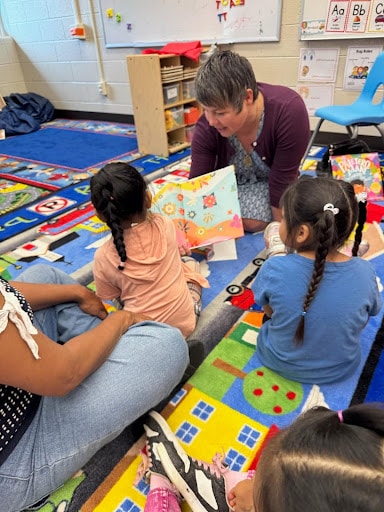
State Rep. Betsy Coffia reading to Northwest Education Services students.
Vision Project Survey – Share Your Input!
Northern Michigan deserves better. House Democrats are taking on corporate greed and political games to rebuild our schools, roads and environment and improve access to affordable housing, food and medications.
I’ve been part of the Vision Project’s core team shepherding this project since winter, and now it’s your turn to shape it. We’ve launched our House Democrats’ Vision Project to hear directly from you about what matters most.
Your voice guides our work. What’s most important to you? Take our brief survey to share your vision for Michigan here.

UIA Overpayment Notices
State and federal law requires Michigan to collect overpayments of unemployment insurance benefits unless repayment has been waived. The Unemployment Insurance Agency (UIA) lifted its full collections pause on Sept. 12, 2025. This means the agency is resuming asking claimants to repay improperly paid benefits. The pause, put in place by the judge of the Saunders v. UIA class action lawsuit through a preliminary injunction in June 2022, prevented the agency from collecting on debt owed to it on claims dating back to March 2020 while the lawsuit was being adjudicated. Additional context and information can be found here.
Overpayments can result from a few things, such as receiving conflicting wage records, not being able and available to work while receiving benefits, or certification issues. Below are some resources for claimants who have been issued overpayment notices:
- Phone: 1 (866) 500-0017 (Option 4, then 1)
- Chat: Via MiWAM
- Appointments: In-person, virtual, or by phone at Michigan.gov/UIA
- Coaching sessions are available for claimants to explain what they need to know about the UIA notice on overpayment of benefits. The link is on the UIA’s home page.
- Frequently Asked Questions
Claimants who disagree with the UIA’s determination can file a protest. A hardship waiver can also be filed if a claimant is not able to repay benefits being sought by the UIA. My office is available to assist any constituents that need help navigating this process. My UIA assistance form can be found here.
Opioid Settlement Update
The Attorney General has secured $1.6 billion for Michigan from companies responsible for the opioid crisis by joining national lawsuits against opioid manufacturers and distributors. Settlement funding will be shared evenly between the state and local governments and will be paid by companies over the coming years to provide a sustainable source of funding to address the opioid crisis.
Local governments have an opportunity to participate in and receive direct payments from the Generic Manufacturer and Purdue/Sackler opioid settlement. The Generic Manufacturer sign-on deadline was Oct. 8 and the Purdue/Sackler sign-on deadline has been extended to Oct. 30. Local governments that need assistance with their participation forms may email the Department of Attorney General for additional instructions before the deadline at [email protected].
Communities in House District 103 are expected to receive the following payments:
- Benzie County
- $14,955.90 (Generic Manufacturer)
- $95,717.78 (Purdue/Sackler)
- Grand Traverse County
- $88,542.06 (Generic Manufacturer)
- $566,669.19 (Purdue/Sackler)
- Leelanau County
- $13,288.97 (Generic Manufacturer)
- $85,049.43 (Purdue/Sackler)
- Traverse City
- $6,661.88 (Generic Manufacturer)
- $42,636.04 (Purdue/Sackler)
Apply for State Boards and Commissions
The governor makes appointments to nearly 250 statewide boards and commissions. These appointments are opportunities for Michiganders to engage with their state government on the issues they care about and represent their expertise and communities at the state level.
Vacancies can be viewed online. Each board listed includes the number of total members, number of vacant seats and specifications for each vacancy.
E-News Archives, Publications and Recognitions
My e-news archive is available on my website here.
State publications on various topics — including veteran benefits, senior resources and taxpayer support — are also available here. Physical copies of any of these publications can also be mailed to you by emailing my office with your request!
Do you know someone in the district who is retiring and would like a legislative tribute to celebrate their years of service? Has a local team or group reached a milestone that they would like to be acknowledged with an official certificate for each member? Our office can provide legislative tributes, letters and certificates on a wide range of recognitions for constituents, community support organizations and local small businesses. If you would like to request any of these materials for yourself or others, please fill out this form or email my office at [email protected]. Please provide as much information as possible, and we will work with you to arrange delivery or presentation of the recognition!