Dear Neighbor,
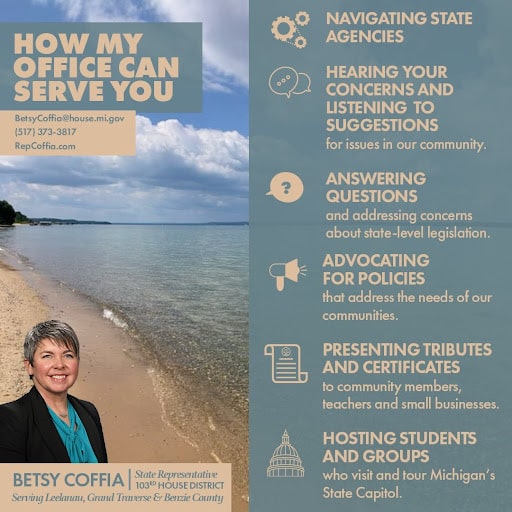
Welcome to my monthly Capitol and Community Updates e-newsletter! As your state representative in the 103rd Michigan Legislature, it has been a pleasure to provide these regular updates on my legislative work in an effort to be as transparent and informative as possible for constituents like you. In this issue, you will find information on my upcoming events, a legislative update, a survey seeking your input on state priorities, news on funding coming to our district, grant opportunity information, resources for how my office can assist you and more!
Neighbors and friends in House District 103 are encouraged to also sign up for these updates at my website, RepCoffia.com. You can reach my office by phone at (517) 373-3817 or by email at [email protected]. Be sure to check out the latest on my social media platforms as well. As this legislative session continues, I welcome your feedback and encourage you to reach out if my team and I can ever be of assistance to you!
In Service,
Betsy Coffia
State Representative
House District 103
Upcoming Events
Please join me at my upcoming town hall on Wednesday, Dec. 3, where we will discuss the need to improve health care access at a time of rising costs, reigning in insurance companies that are driving up costs, the larger health care crisis and one potential solution to the larger health care crisis – MiCare.
A policy proposal championed by my colleague, State Rep. Carrie Rheingans, MiCare (House Bill 4407) is a universal, publicly-funded health care plan that would provide comprehensive, high-quality coverage to every Michigander, without deductibles, co-insurance, co-pays or caps. MiCare would maintain and add to today’s health care provider network, bringing savings to patients, employers and providers by reducing administrative costs, resulting in direct savings for the vast majority of Michiganders.
Rep. Carrie Rheingans will be my special guest at the MiCare Town Hall, as both a public health expert and sponsor of the MiCare legislation.
Can you join us? Please be sure to RSVP as space is limited and registration is required.
Whether you can attend the MiCare Town Hall or not, please share your experience with health care access by taking a short survey here.
MiCare Town Hall
with Special Guest State Rep. Carrie Rheingans
When: Wednesday, Dec. 3, from 6-7:30 p.m.
Where: Unitarian Universalist Congregation of Grand Traverse*
(6726 Center Road, Traverse City, MI 49686)
Remember to RSVP as space is limited and registration is required.
*This event is not affiliated with the Unitarian Universalist Congregation

Legislative Update
Below you will find highlights of recent legislative action. As always, legislation I have sponsored or co-sponsored this term can be found here. Real-time updates on my legislative work can also be found here.
SNAP Legislation & Update
I have been closely monitoring any disruption of food assistance benefits under the Supplemental Nutrition Assistance Program (SNAP) after the President’s Administration refused to release the contingency funds set aside to cover SNAP during a federal government shutdown. The chaos left 1.4 million Michiganders — children, seniors, veterans, disabled folks and working families — who rely on SNAP food benefits uncertain if they would have enough to eat.
It’s important to note that, according to the Center on Budget and Policy Priorities, most SNAP participants who can work do so. Among households who reported receiving SNAP at some point in 2021 and included a non-disabled, working-age adult, 86 percent had earnings in that year. Those that did not have earnings from work included students, caregivers and those looking for higher-paying jobs.
Approximately $260 million per month is usually transferred by the federal government to Michigan to administer SNAP benefits; however, the President’s Administration informed us a week before the Nov. 1 disbursement was supposed to start refilling SNAP benefits, that the money would not be coming. Michigan’s Attorney General immediately sued for the funds to be released, a move I strongly supported. However the funds remained paused as the case was working its way through the courts — causing Michiganders to face hunger while our foodbanks were already overwhelmed this year with record numbers of people in need.
My thinking was this: if the federal government refuses to fund SNAP and Michiganders are facing hunger, that is a true emergency for the people we serve. I strongly maintain we have a moral obligation to do what we can as a decent society to prevent hunger. Michigan has a $2 billion rainy day fund, for example, and I cannot think of a rainier day than 1.4 million of our neighbors, including children, going hungry.
In response to the crisis, my House Democratic colleagues and I worked quickly to introduce a package of three bills and two resolutions that proposed use of state funding for both direct food assistance and support for food banks and pantries. Our press release is available here. The bills in the package are as follows:
- Keeping Food Banks Stocked (State Rep. Betsy Coffia): Provide an additional $12.5 million supplemental for the Food Bank Council of Michigan.
- Securing Fresh Food Access (State Rep. Tonya Myers Phillips): Create a $900 million emergency supplemental for food assistance to SNAP recipients using lapsed project funds.
- Keeping Food on the Table (State Rep. Kimberly Edwards): Provide an additional $12.5 million supplemental for food pantry programs to help those facing food insecurity.
- Resolution (State Rep. Denise Mentzer): Urge the President, the United States Congress, and the United States Department of Agriculture to immediately reopen the federal government or ensure the continued and uninterrupted distribution of SNAP benefits.
- Resolution (State Rep. Reggie Miller): Urge the United States Department of Agriculture to use its contingency fund to support SNAP.
I want to be clear that it is absolutely not sustainable long-term for any state to make up the difference when our already allocated federal tax dollars are withheld for SNAP, heating assistance or many other programs that have been threatened with freezes this year.
Groceries are far too expensive right now and it’s crucial that these benefits get to where they can be most helpful. At a time of great stress for the 42 million Americans who rely on SNAP, I was proud to see so many step in to fill the gap and to love their neighbors with contributions of food and funds to food pantries, including right here in Northern Michigan. I am so grateful to all of the different sectors of our community — food pantries, places of worship, businesses, schools, nonprofits, doctor’s offices and neighbors helping neighbors — who have stepped up in such a beautiful way to make sure that people got fed during such a challenging and uncertain time. Ensuring that children, seniors, veterans, disabled Michiganders, working families, etc. who rely on SNAP do not go hungry is clearly a priority for Northern Michigan.
For those keeping track at home, the courts ruled that the President’s Administration must release the SNAP funds, the Administration challenged the ruling and took it to the U.S. Supreme Court, and in the interim, the federal government shutdown ended. I was grateful to confirm with our departments that, as of Nov. 14, all 1.4 million Michiganders who rely on SNAP had received their food assistance.

State Rep. Betsy Coffia, right, speaking with reporters about her SNAP funding legislation on the House floor.
Health Care Access — A Personal Note
I recently made a public post on my own unexpected need for health care, as well as acknowledging that I believe we are in a health care affordability crisis and that it is worsening with the One Big Beautiful Bill eliminating tax credits for millions of Americans who purchase health insurance on healthcare.gov (also known as Affordable Care Act or the ACA Exchange). This post was adapted and printed into an op-ed that was published in the Traverse City Record-Eagle. The points I made are reiterated below.
If there’s one thing that I know for sure it’s this — access to health care is a necessity. While overall I’ve been lucky to be pretty healthy most of my life, this year was different. Despite never smoking in my life, in June I was diagnosed with a rare form of cancer in my upper palate and had to have major surgery to remove it — because leaving it would have killed me. Also, in an unrelated health diagnosis this year, I had to have a benign brain tumor removed for the second time in five years, a type of brain tumor that grows mysteriously and the medical community doesn’t know why. I have racked up hundreds of thousands of dollars worth of care in over 50 doctor visits since March 2025 from surgery, physical therapy and home health visits, prescriptions, and on it goes.
Folks, nobody can plan for these kinds of emergencies. Health care isn’t a luxury like a yacht or sports car, it’s a necessity. We all need and deserve to get the care we need when we get sick. To me, that is a mark of decent society. Right now, I am extremely grateful to have come through my health crisis and to continue to receive the care I need to heal.
At the same time, I’m very worried about the ability to access care when it comes to my neighbors and constituents here in Northern Michigan and about my fellow Americans across this country.
Why? This summer, the “One Big Beautiful Bill Act” (OBBBA) passed on a party line vote, and one of the provisions in it that I was most worried about was ending premium tax credits that millions of Americans received in order to be able to afford health insurance on healthcare.gov, also known as the Affordable Care Act (ACA) exchange or Obamacare.
I remember sitting in the radiology department waiting to find out whether cancer had spread through my body and watching on my phone from my hospital waiting area as Republicans in Congress chanted “USA, USA” to celebrate passage of OBBBA — I remember it feeling surreal.
OBBBA is poised to shift our tax dollars around in the federal budget away from the healthcare.gov tax credits, to instead provide tax breaks for the top earners in this country.
I am starting to hear some pretty hair raising numbers from people in our community. One couple who run a small local business told me the impact they are bracing for: a $1600 monthly bump if ACA subsidies are not reinstalled, which translates annually to $19,200 for insurance that has an $8000 deductible per person. They said that they will lose their health coverage as a result of OBBBA.
Because I am not in Congress, but rather in the Michigan Legislature, I do not get a vote on whether to reinstate the ACA health care credits that OBBBA is poised to eliminate. However, as the representative of nearly 100,000 people in Northern Michigan and someone who knows all too well how important it is to be able to get care when you need it, what I CAN do is to sound the alarm and urge Congress to act. They need to reverse course and reinstate these premium tax credits for Michigan taxpayers immediately.
Longer term, there is no doubt in my mind we need to move to a system most other wealthy countries already have, where we can all go to the doctor when we’re sick and receive the care we need without it being dependent on how much money we have. Bodies need care, we all get sick and need to go to the doctor, and that should be a given, not a luxury. I say this as a cancer survivor who is incredibly grateful to have been “lucky enough“ that the cancer struck during the relatively narrow window in my life that I have actually had insurance and could get early detection, treatment and recovery care without it breaking me financially. My point is that we all deserve access to care, just like I just received, and it’s entirely possible and being done all over the world right now.
If you are seeing skyrocketing health care costs, please let me know here. I will do everything I can to help amplify these stories and make the case to preserve health care access across our state and country.
Anti-SLAPP Legislation Passes House
Last month, the Michigan House of Representatives unanimously passed House Bill 4045, sponsored by state Rep. Kara Hope. This legislation would allow courts to swiftly dismiss strategic litigation against public participants (“SLAPP”) lawsuits — meritless legal claims that are often used by powerful individuals or corporate entities to silence critics from speaking out on matters of public importance. The goal of a SLAPP lawsuit is not to win, but for the legal process to drain whistleblowers of financial resources. Even the threat of a SLAPP lawsuit can be enough to dissuade a person from speaking out and exercising their First Amendment rights.
SLAPP lawsuits are often brought by wealthy, powerful plaintiffs against defendants with fewer resources, and defending against them can cost individuals thousands of dollars. SLAPP lawsuits undermine the very core of our First Amendment freedoms — the rights of speech, expression and association. This legislation will ensure our courts cannot be misused to intimidate Michiganders, protecting their right to speak out without fear of costly, baseless litigation. This bill would also protect and empower survivors of violence who want to come forward and seek justice, who are too often silenced by the threat of SLAPP suits.
I first learned about this issue in 2012 in talking to local residents and municipal officials in Grand Traverse County, who were targeted by a large corporation for speaking out against a proposed business development. Local residents and local elected officials were harassed for years by these lawsuits. To ensure this never happens again, I was proud to vote in favor of this legislation and that it received unanimous bipartisan support.
Michigan remains one of only 12 states without an anti-SLAPP law. By enacting the anti-SLAPP protections in HB 4045, we would ensure that every person in Michigan can speak out on matters of public concern without fear of retaliatory legal action. The bill now heads to the Michigan Senate for further consideration.
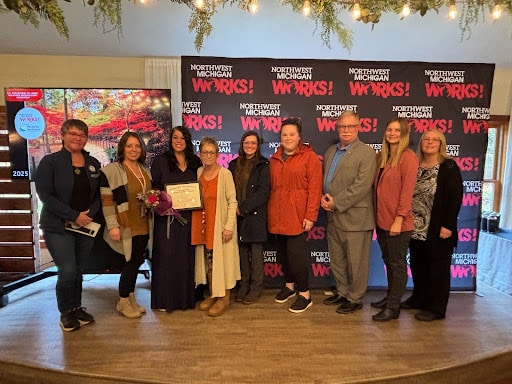
State Rep. Betsy Coffia, far left, attends the 2025 Networks Northwest and Northwest Michigan Works! United States Department of Labor registered apprenticeship graduation.
Registered Apprenticeship Graduation
On Oct. 24, I was honored to attend the 2025 Networks Northwest and Northwest Michigan Works! U.S. Department of Labor registered apprenticeship graduation. The participants were recognized for their completion of U.S. Department of Labor registered apprenticeship programs in a variety of fields, from administrative and health care to manufacturing and construction, along with many more. This celebration signified the participant’s transition from eager apprentice to proficient journeyworker.
As the demand for a highly skilled workforce grows, Northwest Michigan Works! has led the charge in developing quality training programs to fill the needs of employers across the region. Northwest Michigan Works! has served as a U.S. Department of Labor Registered Apprenticeship Sponsor since 2009 and is recognized on the state and national levels for innovative best practices and non-traditional trades. I want to thank the Northwest Michigan Works! Apprenticeship Services Team for inviting me to this event. It was exciting and inspiring to see the pride in these graduates and their families at this significant milestone, and to see many of their employers there to celebrate with them.

State Rep. Betsy Coffia, right, poses with Zorran VanZandt, a graduated first paramedic apprentice with the Leland Fire Department, at the 2025 Networks Northwest and Northwest Michigan Works! U.S. Department of Labor registered apprenticeship graduation.
Meeting with Students of Social Work
I recently had the opportunity to welcome Ferris State University (FSU) social work students and their professor Liz Post to the Michigan State Capitol Building in Lansing. This was especially meaningful to me as an FSU graduate with my own bachelor’s degree in social work. We were joined by state Rep. Carrie Rheingans, who is also a former social worker.
We were delighted to have the opportunity to connect with these students, who represent the future of social work. Their interest in the practice spanned work with a wide range of populations, from child welfare to mental health. We talked about the impact of policy that we make in the legislature on the field of social work, and how their leadership is needed now more than ever to help tackle our toughest challenges and uplift the most vulnerable Michiganders. I am excited to see what this next generation of student leaders will do to change their corner of the world!

State Rep. Betsy Coffia, far left, and State Rep. Carrie Rheingans, second from left, meet with Ferris State University social work students at the Michigan Capitol.
Additional Updates
- House Democrats Introduce Bills to Feed 1.4 Million Michiganders Despite Federal SNAP Pause
- Coffia Provides Additional Updates on Traverse City Pedestrian Bridge Replacement
- Gov. Op-Ed in Washington Post “If we’re going to do tariffs, let’s do them right”
- Findings of State of Michigan Department Reports on National Tariffs: Higher Grocery Prices, More Expensive Housing, Jobs at Risk
- Gov. Signs Executive Directive Expanding Access to Affordable Housing for Younger Michiganders, Putting Money Back in Their Pockets
- Education Budget Continues Free School Meals for All, Saving Michigan Families an Average of Nearly $1,000 a Year
- Parks, trails and waterways on the agenda for DNR’s December public meetings
- Enrollment Open for Nurture Benefits Pilot Supporting Michigan’s Child Care Professionals
- MiLEAP Launches MI Care-Share to Expand Affordable Child Care Benefits for Working Families
Vision Project Survey – Share Your Input!
Northern Michigan deserves better. House Democrats are taking on corporate greed and political games to rebuild our schools, roads and environment and improve access to affordable housing, food and medications.
I’ve been part of the Vision Project’s core team shepherding this project since winter, and now it’s your turn to shape it. We’re launching our House Democrats’ Vision Project to hear directly from you about what matters most.
Your voice guides our work. What’s most important to you? Take our brief survey to share your vision for Michigan here.

More Michiganders Eligible for MiABLE Accounts in 2026
Beginning Jan. 1, 2026, eligibility for the Michigan Achieving a Better Life Experience (MiABLE) program — Michigan’s tax-advantaged savings program for people with disabilities — will expand to include individuals who became disabled before age 46.
Updates to the program are the result of state Rep. Sharon MacDonell’s House Bill 5781, which passed both legislative chambers unanimously last term in strong bipartisan fashion. I was thrilled to vote in favor of the bill in the House.
This historic change means that tens of thousands more Michiganders, including many veterans and people living with conditions such as ALS, Parkinson’s disease or injuries sustained later in life, will qualify to open MiABLE accounts. MiABLE, a Michigan Department of Treasury program, helps individuals and families save for disability-related expenses — from housing and education to assistive technology and transportation — without losing eligibility for federal benefits like SSI or Medicaid.
The expansion represents a major step toward financial inclusion and independence for more Michigan residents with disabilities. More information can be found here.
Funding Coming to the 103rd District
I am pleased to announce that our communities, businesses, and organizations in Benzie, Grand Traverse and Leelanau counties in the 103rd House District have recently been awarded the following state grant funding:
- Traverse City Area Public Schools – $600,000: The Michigan Department of Education (MDE) has awarded this grant through the Clean Bus Energy Grant (CBEG) program. These funds are used to promote student health and environmental protection as part of the clean-power transition for Michigan school transportation. TCAPS will use this funding to purchase two electric school buses.
- Cultured Ferments Company – $93,525 | Lakeview Hill Organic Farm – $100,000: The Michigan Department of Agriculture and Rural Development (MDARD) has awarded these grants through the U.S. Department of Agriculture’s (USDA) Resilient Food Systems Infrastructure Program. Cultured Ferments Company in Traverse City will use the funding to scale up healthy and specialty food and beverage production, while Lakeview Hill Organic Farm in Traverse City will use the grant for processing local farmers’ produce into value added products.
- Village of Northport – $97,482: This grant has been awarded through the Community Service Infrastructure Fund (CSIF) Category B program, administered by the Michigan Department of Transportation (MDOT). This funding will be used to remove existing asphalt surface, level and match existing thickness, add curbs and gutters and replace the sidewalk on Rose Street and Second Street intersections.
- Traverse Connect – $150,000: The Michigan Strategic Fund approved this funding to provide startup support services to boost entrepreneurial capacity and build a pipeline of evergreen funds as part of the first-ever distribution of funds from the Michigan Innovation Fund. By supporting innovators and entrepreneurs in the state, Michigan can grow its population by attracting new and retaining existing residents, as well as promoting our research universities through commercialization of concepts and more.
- Networks Northwest – $1,600,000: The Michigan Department of Lifelong Education, Advancement, and Potential (MiLEAP) announced this funding as part of the Early Childhood Educator Wage Initiative. The initiative will provide monthly stipends — $200 for part-time and $300 for full-time teachers and assistant teachers — while supporting regional efforts to address workforce challenges and strengthen long-term wage stability for early educators. The pilot is designed to encourage coalitions to leverage additional public-private contributions that support sustainable, increased compensation for early childhood educators across Michigan.
Grant Funding Opportunities
Current federal and state grant, loan, scholarship and credit opportunities include:
- Pre-Development Project Accelerator Pilot Program: The Michigan Infrastructure Office Technical Assistance Center (MIO TAC) is offering this grant to municipalities, federally recognized tribes and regional and municipal planning organizations who can apply for up to $50,000 to pay for required infrastructure pre-development activities for surface transportation, transit and drinking and wastewater infrastructure projects under development. Apply by Dec. 1.
- Rural Development Fund Grants: MDARD administers this grant program, which seeks to promote the sustainability of land-based industries and support infrastructure benefiting rural communities in Michigan. Apply by 5 p.m. on Dec. 3.
- America250MI History Program Grants: The Michigan Department of Natural Resources (DNR) announced that the second round of applications for this program is now open for eligible applicants, including tribal governments, 501(c)(3) nonprofit history organizations and local units of government. These grants will help fund projects that interpret, preserve or explore Michigan’s history through educational programming, capital improvements, exhibits, interpretive signs, etc. Apply by Jan. 15.
Apply for State Boards and Commissions
Gov. Gretchen Whitmer makes appointments to nearly 250 statewide boards and commissions. These appointments are opportunities for Michiganders to engage with their state government on the issues they care about and represent their expertise and communities at the state level.
Vacancies can be viewed online. Each board listed includes the number of total members, number of vacant seats, and specifications for each vacancy.
E-News Archives, Publications and Recognitions
My e-news archive is available on my website here.
State publications on various topics — including veteran benefits, senior resources and taxpayer support — are also available here. Physical copies of any of these publications can also be mailed to you by emailing my office with your request!Do you know someone in the district who is retiring and would like a legislative tribute to celebrate their years of service? Has a local team or group reached a milestone that they would like to be acknowledged with an official certificate for each member? Our office can provide legislative tributes, letters, and certificates on a wide range of recognitions for constituents, community support organizations, and local small businesses. If you would like to request any of these materials for yourself or others, please fill out this form or email my office at [email protected]. Please provide as much information as possible, and we will work with you to arrange delivery or presentation of the recognition!