Dear Neighbor,
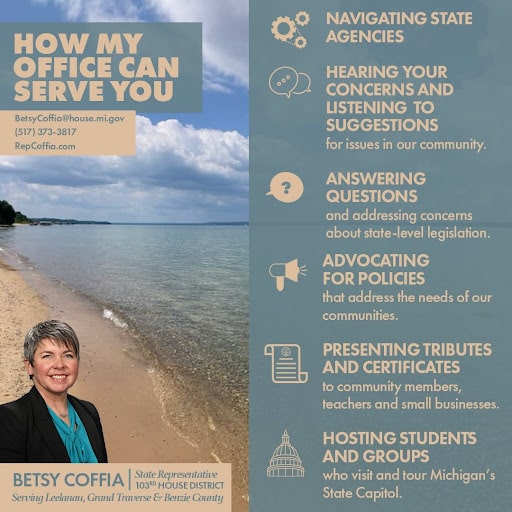
Welcome to my monthly Capitol and Community Updates e-newsletter! As your state representative in the 103rd Michigan Legislature, it has been a pleasure to provide these regular updates on my legislative work in an effort to be as transparent and informative as possible for constituents like you. In this issue, you will find information on my upcoming events, a legislative update, news on funding coming to our district, grant opportunity information, resources for how my office can assist you and more!
Additionally, our Black and Brown northern Michigan neighbors at Northern Michigan E3 have asked that we all commit to read or listen to Dr. Martin Luther King Jr.’s “Letter from Birmingham Jail” in honor of MLK Day this week. The text can be found here, and a recording of the letter read by MLK himself can be found here.
Neighbors and friends in House District 103 are encouraged to also sign up for these updates at my website, RepCoffia.com. You can reach my office by phone at (517) 373-3817 or by email at [email protected]. Be sure to check out the latest on my social media platforms as well. As this legislative session continues, I welcome your feedback and encourage you to reach out if my team and I can ever be of assistance to you!
In Service,
Betsy Coffia
State Representative
House District 103
Upcoming Events
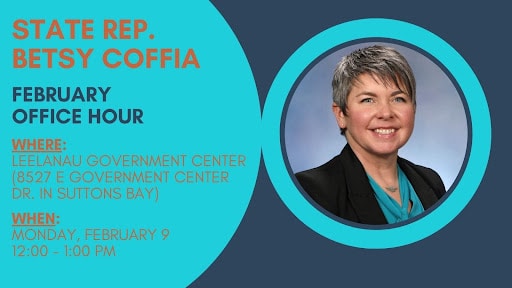
Please join me at my upcoming office hour, where I will give a legislative update and answer your questions about the issues facing our state and our community. These events are a great way to find out what policies I’m working on and to share your ideas and concerns with me!
February Office Hour
When: Monday, Feb. 9, from noon-1 p.m.
Where: Leelanau County Government Center
(8527 E Government Center Dr., Suttons Bay, MI 49682)
Legislative Update
Below you will find highlights of recent legislative action. As always, legislation I have sponsored or co-sponsored this term can be found here. Real-time updates on my legislative work can also be found here.
House Republican Funding Cuts Deemed Unconstitutional
Last month, without any committee discussion, House Republicans voted to cut nearly $645 million in funding that the Michigan Legislature had previously approved in a past budget, a budget that passed with bipartisan support. They did this by utilizing an obscure law that, they argued, allowed them to cut this funding without the approval of the Senate or the governor. The committee chair did not allow questions despite the fact my Democratic colleagues on the committee were handed a list of projects to be cut as the committee was starting. Even as votes were being taken, some members did not know specifically what was being cut, and yet votes were taken anyway in a committee meeting that lasted only minutes.
My legislative colleagues and I only later discovered that the work projects that were cut just as we headed home for Christmas included affordable housing developments, hunger relief, support for children with cancer, free counseling for children who have experienced sexual assault, and assistance for expecting moms and newborn babies. The Michiganders who administer and utilize these programs were promised this funding in an already approved budget. I try to be bipartisan and fair but the reality is that this one-sided vote broke that promise in the least transparent legislative maneuver that I have ever seen.
Senate Democrats quickly responded by passing supplemental legislation to restore most of the funding and state Sen. Sarah Anthony requested that the attorney general issue a formal opinion on the constitutionality of the law that House Republicans used to slash the funding. The House has not taken up the Senate’s bill to restore the funding.
However, the attorney general then issued a formal opinion concluding that a “disapproval” mechanism allowing one legislative committee to unilaterally terminate funding previously appropriated by the full Legislature and the governor is unconstitutional. The attorney general asserted in her opinion that this disapproval mechanism violates both the separation of powers and the bicameralism and presentment requirements in the Michigan Constitution. The Separation of Powers requirement limits the ability of one branch of government to exercise the functions of another. The presentment and bicameralism requirements reflect the constitutional mandate that laws must be debated and passed by both houses of the Legislature and presented to and signed by the Governor. Following the attorney general’s opinion, the State Budget Office resumed issuing payments for these programs.
However, House Republicans have now filed a lawsuit to challenge the attorney general’s opinion and once again cut the funding. While the Michigan Court of Claims adjudicates the constitutionality of the law that House Republicans used to unilaterally cut previously-approved funding, the judge in the case has issued a preliminary injunction to prevent the state from further supporting the slashed programs. Thankfully, some of the funding has already been encumbered or spent, meaning that it cannot be canceled regardless of the court’s decision.
Introduction of STOP Predatory Private Equity Act
According to CNBC, private equity firms are aggressively buying up single family housing stock and are projected to own 40% of all single family rental homes in the United States by 2030. This is exacerbating an already existing crisis in housing prices.
I recently joined my colleague, state Rep. Jason Morgan, in introducing the Shielding Tenants and Owners from Predatory (STOP) Private Equity Act. This legislation takes on predatory housing practices by private equity firms and hedge funds that are driving up home prices and rent across Michigan, from small towns to big cities.
The STOP Private Equity Act discourages corporate hoarding of single-family homes and cracks down on predatory “We Buy Houses for Cash” middlemen. Corporate investors such as private equity firms and hedge funds, often headquartered out of state, are hoarding and mass-buying starter homes, turning home ownership opportunities into rentals and driving up costs for Michiganders. Additionally, predatory “We Buy Houses for Cash” middlemen trick seniors and financially distressed owners into signing contracts that sell their homes for pennies on the dollar. They don’t actually buy the house; they’re just selling the paper contract to a hedge fund for a massive profit (“assignment fee”) that the homeowner never sees.
Our legislation makes corporate home hoarding financially painful by adding a transfer tax on investors buying up the homes in bulk and requiring them to disclose who owns the properties, preventing shell companies from hiding their activities. Violators would be barred from claiming state and local tax credits and economic development incentives. Any tax credits and incentives that they did receive would be required to be paid back, and the investors would be barred from receiving either of these benefits for 10 years following a violation. This legislation also holds cash middlemen, who operate as wholesalers, to the same standard as any other real estate broker. Wholesalers would be regulated under the same terms as real estate professionals, required to disclose their profits, operate under existing licensing rules and provide homeowners with a five-day cooling-off period to walk away from bad deals.
For too many Michiganders, the hope of building a life, buying a first home or putting roots in the community they love has slipped out of reach. Families who have spent years saving and planning are finding themselves outbid by massive private equity firms and hedge funds, often before they are even listed on the market. These predatory entities have bought up homes intended to be the building blocks of young peoples’ futures, hoarded them and manipulated the market to inflate prices.
This package aims to restore these hopes and dreams by pushing back on anti-competitive business practices and return Michigan to the idea that our communities and our homes are for the people.
Company K M-22 Designation Passes House
Part of what we do as legislators is honor Michigan’s history and ensure the legacies of those who shaped it live on. That’s why I worked with Scott Schwander, who is dedicated to preserving tribal history, and with State Sen. John Damoose on legislation he began working on with former Rep. Jack O’Malley to designate a portion of M-22 as the Company K Indian Veterans 1st Michigan Sharpshooters Civil War Memorial Highway. Sen. Damoose’s bill, Senate Bill 41, passed the Senate unanimously in March, and I was proud to vote for a version of that same bill that has now been signed into law by the governor.
This legislation has been a priority for our local tribe, the Grand Traverse Band of Ottawa and Chippewa Indians (GTB), to offer a rare recognition of Native American veterans. Company K is an important piece of Michigan’s story. Made up almost entirely of Native Americans from communities across the state, these soldiers joined the Union Army at a time when they were often turned away because of prejudice and past conflicts. Still, they stepped up and became some of the most skilled sharpshooters in the Civil War.
By naming this stretch of M-22 in their honor, we are making sure their service, sacrifice and contributions are remembered, not just in our history books, but in the places we travel every day. It’s a long-overdue recognition of Indigenous veterans who fought for their communities and for a country that did not always fight for them. Honoring Company K means honoring truth, resilience and the deep roots of Michigan’s Native communities, especially here in Northern Michigan.
Natural Resources Trust Fund Recommends Funding HD 103 Projects
The Michigan Natural Resources Trust Fund (NRTF) Board has made its recommendations for recreation development and land acquisitions project grants for 2026. Several of the recommended projects are located in House District 103. These grants will help to realize these projects and bring significant investments to our communities.
These projects include:
- Ridge Nature Preserve Acquisition (East Bay Township) – $4,813,600
- Cherry Bend Multi-use Trail Project (Elmwood Charter Township) – $400,000
- Veronica Valley Lower Pond Trail Improvements (Leelanau County) – $50,000
- Cedar Run Creek Natural Area Improvements (Long Lake Township) – $133,200
- Extension of the Three Mile Trail (East Bay Township) – $400,000
- Holiday Woodlands Trail Development (East Bay Township) – $300,000
- VASA Trailhead Improvements (Grand Traverse County) – $400,000
The Michigan Natural Resources Trust Fund is a restricted fund that was established in 1976 to provide funding for public acquisition of lands for resource protection and outdoor recreation, as well as for public outdoor recreation development projects. It is funded through interest and earnings on funds derived from the revenues of state-owned oil, gas and minerals.
Please note that the NRTF board’s recommendations will go to the Michigan Legislature for review as part of the appropriations process. Upon approval, the Legislature will forward a bill to the governor for signing.
MiCare Health Care for All Town Hall Debrief
Thank you to the approximately 70 people who braved the winter weather to join me and state Rep. Carrie Rheingans at our MiCare Health Care for All Town Hall last month! Health care is a basic human right, and it’s important for all elected officials to hear directly from people like you about what is going well in our health care system, and what is not, so that we can make appropriate changes that ultimately enhance access to care and health outcomes.
MiCare is a proposed universal, publicly-funded health care plan that would provide comprehensive, high-quality coverage to every Michigander, without deductibles, co-insurance, co-pays or caps. MiCare would maintain and add to today’s health care provider network, bringing savings to patients, employers and providers by reducing administrative costs, resulting in direct savings for the vast majority of Michiganders. The proposal, House Bill 4407, is sponsored by Rep. Rheingans. I am a co-sponsor of this bill.
At the town hall, Rep, Rheingans and I explained the MiCare proposal and opened up the discussion for questions and feedback. We received thoughtful questions and overwhelmingly positive responses. Additionally, leading up to and during the town hall, we circulated a survey asking for folks to share their experiences and thoughts on the current state of health care in Michigan.
House Rules prevent me from including direct quotes from constituents who have agreed to share their responses publicly in my e-newsletters, but the responses tell a powerful story. From Medicare to employer-sponsored health care plans, costs are on the rise across the board and many folks are being signaled to brace for further health care cost increases. Some responders mentioned that costs were already unyielding to begin with, and others have already been left uninsured. Approximately half of the responders indicated support for a cost-effective universal health care for all system, such as MiCare.
The survey remains open should you wish to share your health care experiences and input as well. Thank you to those who have already shared your stories with me! These comments are crucial as I continue to represent northern Michigan interests in the Michigan Legislature by advocating for meaningful change and health care access with my colleagues in Lansing.
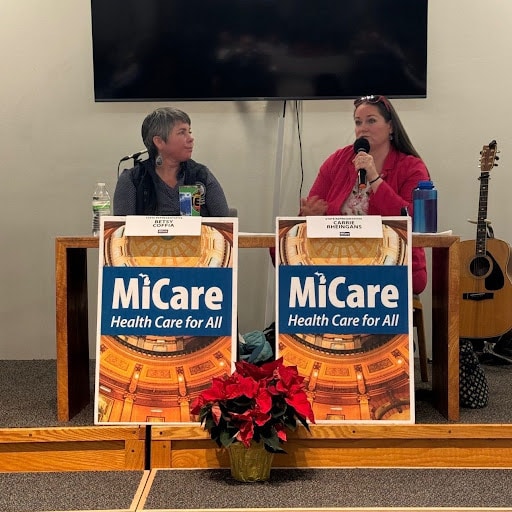
State Rep. Betsy Coffia, left, and state Rep. Carrie Rheingans, right, speaking at the MiCare Health Care for All Town Hall on December 3.
Additional Updates
- Coffia, Rheingans Call for Health Care for All
- AG Nessel Issues Formal Opinion Finding Mechanism Allowing Appropriations Committee to Disapprove Work Projects Unconstitutional
- AG Asks Court to Enforce Order Blocking Trump Administration’s Demands for Personal Data of SNAP Recipients
- Attorney General Petitions MPSC for Rehearing on DTE Data Center Special Contracts
- Puri on AG’s opinion ruling Republican claw-back of $645m in state funds unconstitutional
- House Democrats fight to restore $645 million cut for kids with cancer, new moms and infants; House Republicans say no every time
- MI Republicans vote to give tax breaks to spa-users
- Governor Signs Bipartisan Bills to Lower Costs for Michigan National Guard Members and Their Families
More Michiganders Eligible for MiABLE Accounts in 2026
As of Jan. 1, eligibility for the Michigan Achieving a Better Life Experience (MiABLE) program — Michigan’s tax-advantaged savings program for people with disabilities — has expanded to include individuals who became disabled before age 46.
Updates to the program are the result of state Rep. Sharon MacDonell’s House Bill 5781, which passed both legislative chambers unanimously last term in strong bipartisan fashion. I was thrilled to vote in favor of the bill in the House.
This historic change means that tens of thousands more Michiganders, including many veterans and people living with conditions such as ALS, Parkinson’s disease or injuries sustained later in life, will qualify to open MiABLE accounts. MiABLE, a Michigan Department of Treasury program, helps individuals and families save for disability-related expenses — from housing and education to assistive technology and transportation — without losing eligibility for federal benefits like SSI or Medicaid.
The expansion represents a major step toward financial inclusion and independence for more Michigan residents with disabilities. More information can be found here.
Funding Coming to the 103rd District
I am thrilled to announce that our communities, businesses and organizations in Benzie, Grand Traverse and Leelanau counties in the 103rd House District have recently been awarded the following state grant funding:
-
- Leelanau Conservation District – $72,000: The Michigan Department of Agriculture and Rural Development (MDARD) has awarded this grant through the Forestry Assistance Program. This program helps family forest owners by providing outreach, supporting technical needs and working with local conservation districts to increase the number of family forests that are managed under a sustainable forest management plan.
- Grand Traverse Regional Land Conservancy – $415,673 | The Watershed Center Grand Traverse Bay – $614,993: The Michigan Department of Environment, Great Lakes, and Energy has awarded this funding through the Nonpoint Source (NPS) Program. These funds will support projects that will prevent, reduce or eliminate polluted runoff and other nonpoint sources of pollution — caused when rain, snowmelt or wind carry pollutants from land into lakes, streams or wetlands.
- Herman Park Playground Project – $105,000: The Michigan Department of Natural Resources has awarded this Recreation Passport Grant for the Herman Park Playground Project in Suttons Bay Township. Ten percent of the proceeds from Recreation Passport sales are granted to communities across the state for development and improvement of local public recreation facilities.
- The Michigan Department of Labor and Economic Opportunity has awarded the following funding in the latest round of Going PRO Talent Fund grants for employers to train workers and upskill or advance in high-skill careers. Going PRO helps Michigan workers access short-term, industry-recognized training that leads to better jobs, stronger wages and long-term career stability.
- Medilodge of GTC – $12,195.12
- Medilodge of Leelanau – $8,130.08
- Medilodge of Traverse City – $14,108.08
- RJG Inc. of Traverse City – $31,429.02
- Great Lakes Orthopaedic Center of Traverse City – $17,500.00
- Precision Plumbing & Heating Systems, Inc. of Traverse City – $47,500.00
- Mawby Sparkling Wines of Suttons Bay – $16,400.00
- SEEDS of Traverse City – $10,325.00
- Cultured Ferments Company LLC of Traverse City – $13,000.00
- Pro Image Design of Traverse City – $22,827.50
- Serra Toyota of Traverse City – $156,500.00
- Moore Mechanical of Traverse City – $35,000.00
- Windemuller Electric of Traverse City – $93,076.60
Grant Funding Opportunities
Current federal and state grant, loan, scholarship and credit opportunities include:
- Specialty Crop Block Grant: The Michigan Department of Agriculture and Rural Development (MDARD) is offering this grant for projects that will potentially produce measurable impacts for the specialty crop industry as a whole and not benefit only a specific product or a single organization, institution or individual. Eligible applicants include non-profit organizations; local, state and federal government entities; and for-profit organizations. Applications are due by 5 p.m. on Feb. 5.
- Last Food Mile Grant: MDARD’s Farm to Family Program has launched this new grant opportunity to support the development of transportation and distribution infrastructure for small and medium food producers across Michigan. Applicants must be a Michigan-based farm business or a Michigan-based food business or organization that works directly with Michigan-based farmers to be eligible. Applications are due by 5 p.m. on Feb. 6.
- Children Trust Michigan Primary Prevention Program Grant: The Michigan Department of Health and Human Services (MDHHS) is seeking proposals designed to strengthen communities by promoting the well-being of children and families. Eligible applicants include nonprofits, private and public entities, local health departments and federally recognized tribes. The initial grant period is from April 1 to Sept. 30. All applicants must register and request an application by 5 p.m. on Feb. 6, and applications must be submitted by 3 p.m. on Feb. 13.
- Reconnect Enroll with Momentum Grant: The Michigan Department of Lifelong Education, Advancement, and Potential (MiLEAP) is accepting applications for this grant from Michigan’s community and tribal colleges to work in partnership with county governments to develop strategies that help adult learners start or continue their postsecondary education and earn credentials that strengthen Michigan’s workforce. Applications are due by 3 p.m. on Feb. 27.
- Equine Grant Program: MDARD and the Michigan Horse Racing Advisory Commission (HRAC) are offering this grant to entities to support the promotion and marketing of horse racing, equine-related research, equine-related support and aftercare and other equine-related or horse racing programs. Proposals are due by 5 p.m. on Feb. 27.
- County Fairs Capital Improvement Grant Program: MDARD is offering this grant opportunity for building renovations, infrastructure upgrades or capital improvements that enhance the productivity, usefulness or longevity of fairground facilities. Applications are due by 5 p.m. on Mar. 18.
Apply for State Boards and Commissions
The governor makes appointments to nearly 250 statewide boards and commissions. These appointments are opportunities for Michiganders to engage with their state government on the issues they care about and represent their expertise and communities at the state level.
Vacancies can be viewed online. Each board listed includes the number of total members, number of vacant seats and specifications for each vacancy.
E-News Archives, Publications and Recognitions
My e-news archive is available on my website here.
State publications on various topics — including veteran benefits, senior resources and taxpayer support — are also available here. Physical copies of any of these publications can also be mailed to you by emailing my office with your request!
Do you know someone in the district who is retiring and would like a legislative tribute to celebrate their years of service? Has a local team or group reached a milestone that they would like to be acknowledged with an official certificate for each member? Our office can provide legislative tributes, letters and certificates on a wide range of recognitions for constituents, community support organizations and local small businesses. If you would like to request any of these materials for yourself or others, please fill out this form or email my office at [email protected]. Please provide as much information as possible, and we will work with you to arrange delivery or presentation of the recognition!