Dear Friends and Neighbors,
Happy Holidays! I hope that everyone will be able to enjoy this holiday season. As always, it is an honor to represent the residents of the 69th House District and Genesee County. The purpose of this e-newsletter is to keep you updated on my work in Lansing and around our community.
As many of you know, the longest government shutdown in U.S. history ended on Nov. 15, and while it will take some time to receive benefits from SNAP, WIC and the Department of Veterans Affairs as well as to get federal workers back on their feet, those funds will be available through at least Jan. 30.
If your household is still being impacted by the effects of last month’s shutdown, please know that help is available:
- Dial 2-1-1 or visit Find Help – Michigan 2-1-1 for confidential referrals to local food programs and services.
- Visit the Food Bank Council of Michigan to locate nearby food banks and hunger relief efforts.
- Check your MI Bridges account for the latest updates on SNAP benefits.
Links to where you can find Genesee County food banks can be found at the end of this newsletter in our resources section. In between these updates, I encourage you to please follow me on Facebook or Instagram where myself and my office post frequent updates. You can also always get in touch with us, through our website, office number (517) 373-1786 and by email [email protected]. We are here to serve you.

Jasper R. Martus
State Representative
69th House District
Office: (517) 373-1786
Email: [email protected]
In this Edition:
- Lansing Updates
- In-District Event Updates
- Resources
LANSING UPDATE
Restoring Farmer Suicide Prevention Program Funding with Rep. Bierlein
Across Michigan, farming is more than an occupation. It is a generational commitment to stewardship, honor and legacy-building. Beyond its idyllic perception, the industry harbors an overlooked reality: Michigan farmers experience suicide and mental health crisis rates far higher than the general Michigan and U.S. population. Financial pressure, unpredictable weather patterns, market volatility, crop and livestock illness and an isolated lifestyle have exacerbated the problems of our agricultural communities. These matters demand attention, not neglect.
That is why the lapse of state funding for the “Legacy of the Land — Managing Farm Stress” program, was troubling. Through this critical program, Michigan State University Extension provided farmers with free, confidential counseling and mental health resources that worked for their needs and lifestyles. An important part of representing our constituents is meeting folks where they’re at — whether in moments of resilience or tragedy, and with services that reflect their needs.
The decision to not include funding for this program in the most recent state budget concerned not just myself but state Rep. Bierlein as well. As mid-Michigan representatives, we know that the farmers of our districts could be left with fewer options for recourse and higher costs during an already tumultuous season.
Our state legislature is a consequential one, affecting the families, local economies and future of rural Michigan. In response, our offices have led the charge of signing an open letter to the Michigan House Appropriations Committee chair to restore this funding. We are committed to representing the cause, but it will take a genuine effort to amplify the issues of rural Michigan to change public perception.
We came together because we understand that this issue is not a partisan one. It is an obligation to our constituents, their way of life and the essential industries that continue to fuel growth in our state. The Legacy of the Land program is a lasting commitment to those that feed our state, a commitment better shared than faced alone.
What to Focus on in the New Year: A New Plan for Economic Development
With this year’s state budget finally in our rearview and as we prepare to take on another budget cycle, a lot of folks may be wondering: what’s next? Something that I have been focused on is the future of economic development in Michigan. With both large economic development programs like the Strategic Outreach and Attraction Reserve (SOAR) fund on their way out, with their annual $500 million deposit not included in next year’s budget and smaller programs like the $22 million reduction for the Michigan’s Going Pro Talent Fund, the Michigan Economic Development Corporation (MEDC) is left with a 46.7% cut in their total funding to do the work of business development, job awareness and community development in Michigan. So what is next for the state of Michigan working to grow Michigan’s economy?
The Michigan Speaker of the House gave an interview to Bridge Michigan in which he presented his vision for economic development which includes the elimination of further tax credits, including the defunct Michigan Economic Growth Authority or MEGA, which are still expected to cost the state $2.5 billion through the 2032 tax year. He has also insisted upon the MEDC not being the future administrators of economic development programs in Michigan. In Hall’s vision, along with state Reps. Mark Tisdel and Sarah Lightner, they offered a package (HBs 5292 and 5293) called “Real Jobs for Michigan,” whereby businesses could qualify for incentives if they create permanent, full-time jobs and pay at least 150% of the median hourly wage for whichever prosperity zone that business resides in. If they are able to do this, businesses would be eligible for a payroll tax credit equal to 50% of the income tax withheld for each new employee. These credits would be capped at $50 million and run through the 2036 tax year with all businesses being eligible.
My Democratic colleagues in the Senate, led by state Sen. Sam Singh, who are in dialogue with House Republicans, presented their own proposal for economic development (SBs 472 and 473) known as “More Jobs for Michigan”. This proposal would seek to have incentives available for companies to create jobs at a certain percentage of an area’s median wage relative to the number of people a business employs. For instance, smaller businesses would pay 175% of an area’s median wage whereas larger businesses would be 150%. Additionally, these businesses would be required to invest $100,000 per employee into “hard investments” within five years of landing in Michigan. This would include investments into site readiness, retooling facilities, building brand-new infrastructure, offering workforce development programs and child care access initiatives. The withheld income tax dollars of the jobs created by the company are then put into the Michigan Strategic Fund and can be used to make improvements to the business, as long as they reach certain benchmarks that they agree to with the MEDC, and if not those benefits are clawed back. If these businesses are seeking to join this program, they are already in a program, like MEGA, would not be eligible to join this program.
In my short time here, I have worked to bring Michigan in line with the rest of the country to ensure that when we are competing for critical industry and high wage jobs, we are playing with a full deck. That is why I was so passionate to pass the Michigan Research and Development tax credit and see through the creation of the Office of Economic Transition, with Sen. Singh, to ensure Michigan has that full deck. I believe that there is potential with both of these plans, but Sen. Singh’s does not include a cap on the tax credits they can receive. What these caps end up doing is limiting how much assistance we can give to these businesses and then further restricting which businesses can actually apply for this benefit due to their size. Every business would get to share a pool of $50 million per year for 10 years, which would mean less jobs overall for Michigan in places that already have plenty of jobs like Detroit and Grand Rapids. Meanwhile, the revamped “More Jobs for Michigan” does not include these caps and instead allows for their growth to be determined relative to an area’s level of economic need. For instance, our own Genesee county’s median household income is around $60,000. A smaller advanced auto manufacturing company looking to expand into our region could take advantage of the Singh plan, enter a 10 year agreement with the MEDC, hit their benchmarks and offer more high wage paying jobs for $105,000.
These are the ideas I’m keeping in mind as I continue to work to make Michigan’s economic development future as competitive as it can be.
IN-DISTRICT EVENT UPDATE
Recent Community Events
While I always appreciate getting to hear and connect with constituents, this December, I will not be hosting a coffee hour and will resume coffee hours in the new year on Monday, Jan. 5, at 10 a.m. at the Flushing Senior Center, 106 Elm St., Flushing, MI 48433. My favorite part of this job is getting out with the community, talking with them and hearing what issues matter to them. I’m hosting a series of coffee hours this year, and I invite you all to stop by any of them to express your thoughts on the issues that surround our community.
Coffee Hour Follow-Up
Something new I’d like to include in this update is a Coffee Hour Follow-Up section where my staff and I give more information on questions that we were not able to answer fully or could be explained further that were asked at the most recent coffee hour. My previous coffee hour was at the Flint Township Senior Center on Friday, Nov. 14. Here are some of the topics and questions I’d like to follow-up on:
Senior homeowner/renter payment assistance in the FY ‘26 budget:
One question we received came from a constituent who was curious about a program that was included in this year’s budget that was meant to help senior home owners/renters with payment assistance. While there were not specifically senior home owner or renter payment assistance included in the budget, there are programs that exist through MSHDA that are available including the MI 10K Down Payment Assistance Program, which helps homebuyers with low and moderate incomes by providing up to $10,000 toward down payment, closing costs and prepaid expenses. All interest free. More information on this program can be found here.
Additionally, the First-Generation Down Payment Assistance Pilot Program also exists to help first-generation homebuyers to cover down payment, closing costs and prepaid escrows. Unfortunately, all available funds for this program have been exhausted and MSHDA is operating on a waitlist at the moment. More than $8 million were allocated to 320 families across Michigan to help them afford their first home. More information on eligibility and updates to this program can be found here.
A non-budget related bill that could affect Michigan seniors as it relates to their property taxes is a bill in the Senate proposed by state Sen. Michele Hoitenga, SB 292, which would would end property taxes for anyone over the age of 70, and Michigan seniors would not need to be retired to qualify for this proposed tax cut. It was introduced on May 13 and was referred to the Committee on Finance, Insurance and Consumer Protection.
HB 4588 Concerns
My office has seen these concerns for HB 4588 not just at our coffee hours, but also in our inbox and our answering machines. And for good reason. What this bill seeks to do is change the way local elections would operate — claiming egregious statistics as sources for justifying partisanship for “transparency.” Notably, however, not all Republican members of the House Elections Integrity Committee are in favor of the reform. In tandem with Democratic colleagues, members questioned what the purpose and intention behind such legislation could be other than to sow divisiveness. Making school board elections partisan, slights the opportunity for communities to find effective representation from qualified community backgrounds without the influence of the deeply dividing national political climate. A classroom’s mission is to support learners through learning, not replicating the work of politicians.
Changes to 31aa funds for school safety and mental health coaches:
In order to get the school budget across the line, a number of compromises had to be made, such as the changes made to Michigan’s section 31aa school funding. This funding provides a grant to eligible school districts with funds to support mental health and school safety expenditures. The mental health expenditures can include hiring or contracting for support staff for student mental health needs, that include, but are not limited to, school psychologists, social workers, counselors and school nurses. Some school safety supports include training for school staff on threat assessment, training for school staff and students on threat response and training for school staff on crisis communication. For the 2025-2026 budget, $321 million was set aside for this particular set of funding this year, but with a provision that any of these grants that are awarded, the school districts waive “must agree to be subject to a comprehensive investigation, must affirmatively agree to waive any privilege that may otherwise protect information from disclosure in the event of a mass casualty event, and must agree to comply with a comprehensive investigation.” This means that were a “mass-cauality” event were to occur on their campus, the school would have to waive their attorney-client privileges and comply with a state led investigation into the event.
Concerns that school-districts have with the language are the broad circumstances and lack of how long attorney-client privilege would be waived for is the concern that many school districts have. It has put these districts in a spot where they either take this funding for important resources and waive their legal rights, or they protect their legal rights, but miss out on millions of dollars in funding for addressing ever more important issues for students in mental health and school safety. This concern is to the point that some school districts are suing the state over this language. With the deadline of Nov. 30 passing for schools to opt-in or out of the program and ongoing lawsuits, I will be sure to work with my colleagues who are working with certain school districts so that if a supplemental appropriations bill is passed, they will include language that will be more clear what the state is looking for with these provisions from school districts.

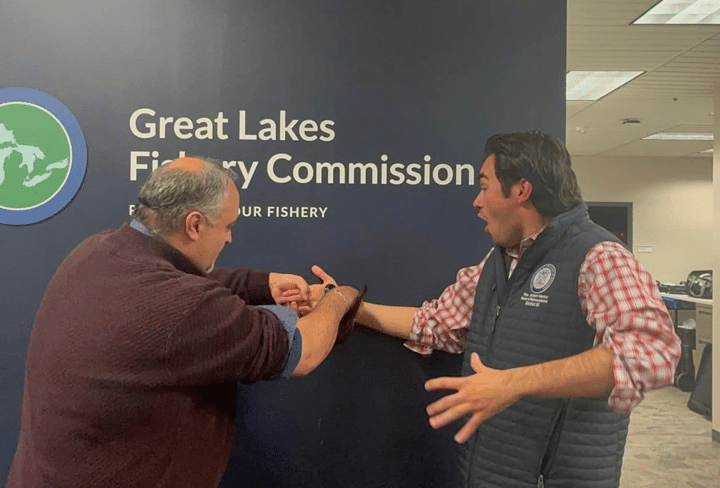

Meeting with the Great Lakes Fishery Commission and the before, during and after images of my hand being “hugged” by a sea lamprey, Dec. 2
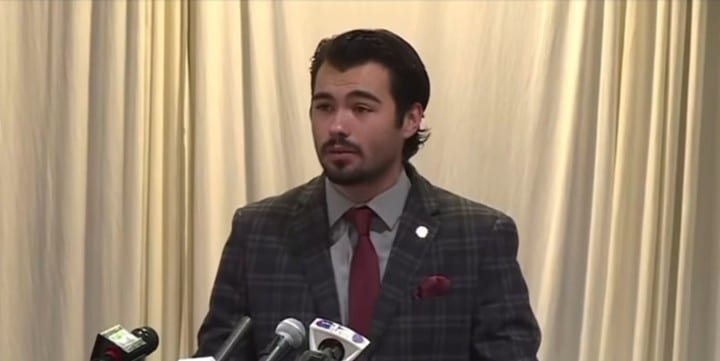
Speaking at St. George Preschool in Flint Township on universal preschool, Nov. 18
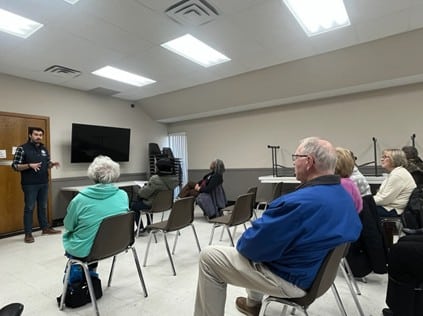

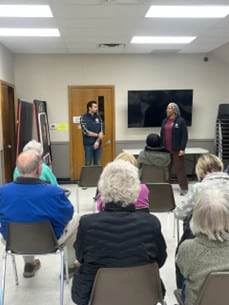
Speaking with constituents at Flint Township Coffee Hour, Nov. 14
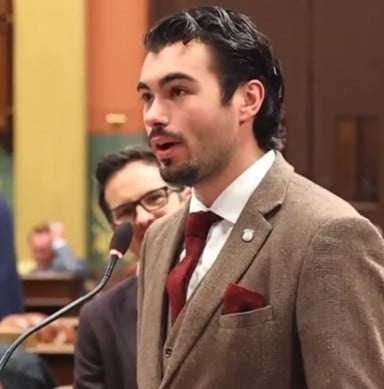
Introducing a resolution on the House Floor for Michigan Historical Music Week, Nov. 7
Coffee Hours
If you haven’t got the chance to stop by yet, I hope to see you there!
- Monday, Jan. 5: Flushing Area Senior Center, 10 a.m.
More dates to be announced soon!
RESOURCES
Below is a compiled list of federal, state and local information and resources that may be useful to you.
State and Local Resources
- Consumers Energy Outage Map
- Consumer Complaint Form (AG)
- Coronavirus Info
- Michigan 2-1-1
- State Emergency Relief (SER)
- Apply for a Home Heating Credit
- Unemployment Benefits
- Poverty Exemption for Property Tax
- Renter’s Rights
- Michigan Homeowner Assistance Fund
- Genesee County Food Banks
State and Federal Government Contacts
- State Representative Jasper Martus
- 69th House District Map
- State Senate
- State House of Representatives
- Michigan Legislature
- U.S. Senate
- U.S. House of Representatives
Metropolitan District, City, Township and County Governments
- Genesee County
- Beecher Metropolitan District
- City of Clio
- City of Flushing
- City of Montrose
- City of Mt. Morris
- City of Swartz Creek
- Township of Clayton
- Township of Flint
- Township of Flushing
- Township of Montrose
- Township of Mt. Morris
- Township of Vienna
I WANT TO HEAR FROM YOU
I want to hear from you. What do you need? How can we help you? My office is here to assist you or answer any questions you may have. Please reach out to me by phone at (517) 373-1786 or email at [email protected].